
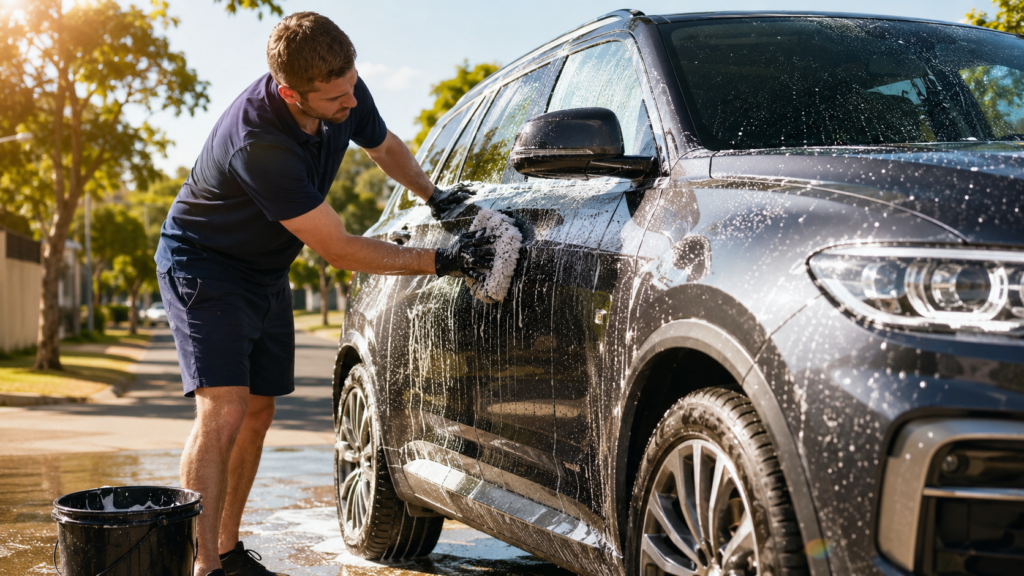
Someone at the servo will tell you weekly. Your dealer will tell you fortnightly. Your mate with the ute will tell you “whenever it rains, mate.” None of them are wrong exactly, but none of them are answering your actual question either. The real answer depends on where you park, what you drive, and how much you actually care about resale value versus just not looking like a dust magnet.
This guide gives you a straight, science-backed answer for Australian conditions, not a generic checklist written for a country with actual seasons.
The Short Answer: It Depends on These 3 Factors
If you want the number and nothing else: most daily-driven cars in Australia need a proper wash every 1 to 2 weeks. But that number moves based on three things:
● Exposure: Garaged cars can stretch to monthly. Street-parked cars under trees or near the coast can’t.
● Contaminants: Bird droppings, tree sap, salt air and construction dust are acidic or abrasive, and they don’t wait for your schedule.
● Your goals: Daily runabout versus a car you plan to sell in three years for top dollar are two very different maintenance conversations.
Get those three right and you’ll land on a schedule that actually protects the car instead of just making it look presentable for the weekend.
Why Washing Your Car in Australia Is Different
Most car care content online is written for the UK or the US, where the enemy is road salt in winter. In Australia, the enemy is UV radiation, and it’s relentless for most of the year. That changes the maths on how often you need to wash, and more importantly, why.
The Sun vs. Your Clear Coat
Australia sits under one of the harshest UV loads on the planet. UV breaks down the clear coat on your paint over time, and dirt sitting on top of that clear coat acts like sandpaper under a magnifying glass every time the sun hits it. Dust particles absorb heat, sit against the paint, and micro-scratch the surface as the car moves or as wind blows grit across it.
This is the bit most people miss: it’s not the dirt itself that does the damage, it’s dirt plus UV plus time. A car sitting dirty in full sun for three weeks is ageing faster than the same car washed weekly, even if neither one gets a scratch you can see.
The “Bird Poop” Threat
Bird droppings are genuinely one of the fastest ways to damage clear coat in Australia, and it’s not close. They’re acidic, and in summer heat that acidity gets baked into the clear coat within hours, not days. If you get bird droppings on the car, the rule is simple: don’t wait for wash day. Spot clean it within 24 to 48 hours with water and a proper pH-neutral wash solution, or you’re looking at etching that no amount of polishing fully reverses.
The Ultimate Car Wash Schedule (By Use Case)
Here’s where the generic advice falls apart, because “how often should you wash your car” doesn’t have one answer. It has three, depending on how the car is actually used.
Daily Drivers (Commuting)
Every 1 to 2 weeks, non-negotiable. Daily drivers accumulate brake dust, road grime, insect strikes and general urban pollution constantly, and most commuters park at least partly exposed to sun. If you’re commuting through anywhere with construction dust or near industrial areas, lean toward the weekly end of that range.
Weekend Cars (Garaged)
Every 3 to 4 weeks is usually enough, since garaging removes most of the UV and contaminant exposure that drives wear. The trade-off is that garaged cars accumulate dust from sitting still, and that dust can be surprisingly abrasive if you skip straight to a wipe-down instead of a proper wash. Don’t let “it’s garaged” turn into “I never need to wash it.”
Off-Road / 4WD Vehicles
After every trip, ideally. Mud, salt (if you’ve been near the coast or a beach), and organic matter trapped in the undercarriage will corrode components a lot faster than paint damage on the surface. This is less about how the car looks and more about what’s happening underneath where you can’t see it.
Signs Your Car Needs a Wash (Even If It Looks Clean)
A car can look fine from three metres away and still be due for a wash. Here’s what to actually check:
● Run a hand (or a clean plastic bag) over the paint. If it doesn’t feel glass-smooth, there’s contamination sitting on the surface.
● Water beading has slowed down or stopped. That’s a sign any existing wax or sealant is compromised and grime is starting to bond to the paint.
● Visible spotting from rain, sprinklers, or coastal air, even if the panels look “clean” otherwise.
● Wheel arches and lower panels holding grit that isn’t obvious from a standing look.
If any of that sounds familiar and you’d rather not do it yourself, a hand car wash in Perth gets the contamination off properly without the risk of a rushed home wash creating swirl marks.
Does a Dirty Car Really Affect Resale Value?
Yes, and the effect is bigger than most owners assume. Dealers and private buyers alike use visible condition as a proxy for maintenance history, fairly or not. A car with etched clear coat from bird droppings, sun-faded paint, or visible swirl marks reads as “neglected” even if the engine and service history are immaculate.
The paint condition specifically tends to move valuations more than interior wear, because paint damage is the first thing a buyer or a dealer’s appraiser sees, and it’s the hardest thing to fix cheaply. Regular washing prevents the UV-plus-contaminant damage described above, which is the actual mechanism behind paint degradation, not just “looking dirty.”
If resale value is genuinely the priority rather than just weekly upkeep, a paint protection service does more for long-term value retention than any wash frequency alone, since it addresses the clear coat’s vulnerability directly rather than just managing the symptoms.
How Victoria Park’s Climate and Traffic Affect Your Wash Schedule
If you’re based around Victoria Park, a few local factors push you toward the more frequent end of the schedules above. The area sits close to the Swan River, which means higher ambient humidity and, depending on wind direction, some exposure to airborne salt that behaves similarly to coastal salt in terms of accelerating corrosion on wheels and undercarriage components.
Victoria Park is also a high-traffic corridor with a mix of established street trees along residential stretches and denser commercial strips near Albany Highway and the café strip. That combination means daily drivers in the area are dealing with a fairly aggressive mix of sap, dust and general traffic grime, on top of the standard UV load every Perth suburb gets. Street parking is common here too, which removes the shelter that garaged weekend cars elsewhere in Perth get to rely on.
Practically, that means most Victoria Park daily drivers sit closer to the weekly end of the 1 to 2 week range rather than the fortnightly end. If you’re local, Silver Sponge Victoria Park is set up for exactly this kind of frequent, no-fuss wash without needing to book weeks ahead.
Frequently Asked Questions about Car Washing Frequency
Is it bad to wash your car too often?
Not if you’re using a proper pH-neutral wash and the right technique. The damage people associate with “washing too much” almost always comes from poor technique (dirty mitts, drying with old towels) rather than frequency itself.
Can I just rely on rain to clean my car?
No. Rain in Australia often carries dust and pollutants, and it dries into water spots that etch into the clear coat over time, especially in hard water areas. Rain is not a substitute for a wash.
How often should you wax or seal your car after washing?
Every 2 to 3 months for a traditional wax, or every 6 to 12 months for a ceramic sealant. Either one reduces how much contamination bonds to the paint between washes, which is part of why weekend cars can stretch their wash intervals further than daily drivers.
Does washing your car at home damage the paint?
It can, if you’re reusing a dirty sponge, using dish soap (too alkaline for clear coat), or drying with a rough towel. The two-bucket method and a pH-neutral car shampoo largely eliminate this risk.
Conclusion: Find Your Perfect Wash Routine
Forget the one-size-fits-all advice. Work out which category your car falls into: daily driver, weekend car, or off-roader, and use the ranges above as your starting point, then adjust based on what you’re actually seeing on the paint. In Australian conditions specifically, the real driver of damage isn’t the dirt itself, it’s UV plus time plus contamination sitting on the surface. Wash on that logic and you’ll protect both the paint and the resale value, without turning it into a weekly chore you resent.