A touchless car wash sounds like the perfect solution for keeping your vehicle clean without putting brushes, sponges or wash mitts anywhere near the paint.
Instead of physically contacting the vehicle, a touchless system uses high-pressure water and cleaning chemicals to loosen and remove dirt. That approach has an obvious appeal, particularly for drivers concerned about swirl marks, scratches and paint damage.
But there is an important question that often gets overlooked:
Is a touchless car wash actually better for your car?
The answer is more complicated than a simple yes or no.
A well-designed touchless wash can reduce the amount of physical contact with your vehicle, which may help minimise the risk of introducing certain wash-related marks. However, removing dirt without touching the paint also has limitations. Heavy road grime, traffic film, oily deposits and stubborn contaminants can remain behind when the cleaning process relies entirely on water pressure and chemicals.
For everyday vehicle maintenance, the best washing method depends on the condition of the vehicle, the type of contamination, the paint protection already applied and the finish you want to achieve.
In this guide, we explain how a touchless car wash works, its advantages and disadvantages, whether it is safe for car paint, and when a professional hand wash or detailing service may be the better choice.
What Is a Touchless Car Wash?
A touchless car wash is a vehicle cleaning system that does not use brushes, wash mitts, sponges or other equipment that physically contacts the vehicle’s exterior paint.
Instead, the cleaning process generally relies on:
- Pre-rinse or high-pressure water
- Specialised cleaning chemicals
- Pressure washing
- Rinsing
- Drying, depending on the system
The basic principle is straightforward: loosen contamination chemically and remove it with water pressure rather than physically scrubbing it away.
This differs from a traditional hand car wash, where a technician can inspect the vehicle and use appropriate washing equipment to work on specific areas.
That distinction matters because not all dirt behaves in the same way.
Loose dust is relatively easy to remove. Dried mud, road film, bird droppings, insect residue, grease and embedded contaminants can require a more targeted approach.
How Does a Touchless Car Wash Work?
Although systems vary, a typical touchless wash follows several stages.
1. Pre-rinse
Water is applied under pressure to remove loose dirt and reduce the amount of contamination sitting on the vehicle.
This stage is important because removing loose particles before further cleaning can reduce unnecessary abrasion.
2. Chemical application
A cleaning solution is applied across the vehicle.
The purpose is to break down or loosen contaminants so they can be rinsed away more easily.
The effectiveness of this stage depends on factors such as:
- Chemical formulation
- Concentration
- Water temperature
- Dwell time
- Type of contamination
- Condition of the vehicle
3. High-pressure rinse
High-pressure water is then used to flush away loosened contamination.
Areas such as wheel arches, lower doors, bumpers and rocker panels may require particular attention because these areas commonly collect heavier road grime.
4. Final rinse
A final rinse removes remaining cleaning solution and loosened contamination.
5. Drying
Depending on the system, drying may involve air blowers, a drying cycle or another method.
A poor drying process can leave water spots, particularly where mineral-rich water is allowed to evaporate naturally on the paint.
Change block type or style
Move Heading block from position 38 up to position 37
Move Heading block from position 38 down to position 39
Change alignment
Change text alignment
Displays more block tools
Is a Touchless Car Wash Safer for Your Paint?
It can be, but “touchless” does not automatically mean “risk-free”.
One obvious advantage is that there is no brush or wash mitt physically moving across the paint.
That means there is less opportunity for a contaminated washing tool to drag particles across the surface.
However, paint protection is not determined by contact alone.
A touchless wash still involves:
- Cleaning chemicals
- High-pressure water
- Existing contamination
- Water quality
- Drying
- The condition of the paint
If a vehicle has heavy contamination that the touchless process cannot remove, the remaining dirt may still need another cleaning method.
This is one reason professional vehicle cleaning should be based on the condition of the vehicle rather than a single washing technique.
Touchless Car Wash vs Hand Car Wash
The biggest difference is control.
A touchless system follows a largely predetermined cleaning process. A professional hand wash allows the technician to assess the vehicle and respond to what is actually on the surface.
| Feature | Touchless Car Wash | Professional Hand Wash |
|---|---|---|
| Physical contact | Minimal or none | Controlled contact |
| Dirt removal | Relies heavily on chemicals and pressure | Combines products, tools and technique |
| Heavy contamination | May struggle | Can be treated individually |
| Vehicle inspection | Limited | More detailed |
| Attention to problem areas | Limited by system | Can be targeted |
| Convenience | Usually quick | Depends on service |
| Detailing options | Limited | Can include additional services |
| Best for | Routine light cleaning | More thorough vehicle care |
Neither approach is automatically right for every vehicle.
For a lightly dusty car that needs a quick clean, touchless washing can be useful.
For a vehicle with accumulated grime, stains, road film or specific problem areas, a more controlled professional wash may produce a better result.
The Main Benefits of a Touchless Car Wash
Reduced physical contact
The most obvious benefit is the reduced contact between cleaning equipment and the paint.
For vehicle owners particularly concerned about wash-induced swirl marks, this can be appealing.
Convenient for regular cleaning
Touchless systems can provide a convenient way to remove loose dirt and surface contamination without a lengthy cleaning process.
Regular washing is generally preferable to allowing contaminants to accumulate for long periods.
Useful for lightly contaminated vehicles
If your vehicle is carrying mostly dust and loose road grime, a touchless wash can remove a significant amount of surface contamination.
Useful as part of a maintenance routine
A touchless wash can be one component of a broader vehicle maintenance routine.
However, it should not necessarily replace more thorough cleaning when the vehicle requires it.
The Limitations of Touchless Car Washing
The biggest misconception is that “touchless” means the vehicle will be cleaned perfectly without physical contact.
That is not always the case.
Heavy dirt can remain behind
High-pressure water can remove loose contamination, but some substances bond more strongly to automotive surfaces.
Examples include:
- Road film
- Grease
- Tar
- Insect residue
- Tree sap
- Dried bird droppings
- Embedded mineral deposits
These contaminants may require specialised treatment.
Strong chemicals are not automatically better
A touchless system needs effective cleaning chemistry because it cannot physically agitate the surface.
That can create a trade-off.
Cleaning products need to be strong enough to break down contamination while remaining appropriate for the vehicle’s surfaces and existing protection.
Incorrect chemical selection, concentration or dwell time can create problems.
It cannot replace detailing
A touchless wash is primarily a cleaning process.
It does not normally address issues such as:
- Paint imperfections
- Swirl marks
- Oxidation
- Interior stains
- Pet hair
- Leather conditioning
- Paint decontamination
- Paint correction
These require more specialised vehicle care.
Can a Touchless Car Wash Remove Bird Droppings?
It may remove fresh or loose bird droppings, but stubborn or dried contamination can be more difficult.
Bird droppings should not be allowed to remain on automotive paint unnecessarily.
The safest approach is to soften the contamination and remove it using an appropriate method rather than aggressively scrubbing the surface.
This is particularly important during hot Australian weather, when contaminants can dry rapidly on exposed paintwork.
If the vehicle has repeated staining or etched areas, a normal wash may no longer be enough. Paint correction or professional detailing may be required to improve the appearance.
Are Touchless Car Washes Safe for Ceramic Coatings?
A touchless wash can be suitable for maintaining a ceramic-coated vehicle, but the products used matter.
Ceramic coatings are designed to provide additional surface protection and hydrophobic behaviour, but they still require proper maintenance.
Owners of ceramic-coated vehicles should avoid assuming that any car wash chemical is automatically compatible with their coating.
A sensible maintenance approach includes:
- Use appropriate cleaning products.
- Avoid unnecessarily aggressive chemicals.
- Rinse thoroughly.
- Do not allow chemicals to dry on the surface.
- Follow the coating manufacturer’s maintenance recommendations.
- Arrange professional maintenance when the coating or paint requires additional attention.
For vehicles requiring more comprehensive protection, Silver Sponge also offers ceramic coating as part of its detailing services.
What About Touchless Washing During Winter or Wet Weather?
A common mistake is to think that rain means a car does not need washing.
Rain can remove some loose dust, but it does not necessarily remove the road film and contaminants accumulated during everyday driving.
Water can also carry dirt onto lower body panels and leave contamination behind as it dries.
Regular washing helps prevent contamination from building up.
The ideal frequency depends on:
- How often you drive
- Where you park
- Road conditions
- Weather
- Whether the vehicle is garaged
- Paint protection
- How quickly contamination accumulates
Rather than following an arbitrary schedule, inspect the vehicle and wash it when contamination becomes noticeable.
When Is a Hand Car Wash the Better Choice?
A professional hand wash becomes particularly useful when the vehicle needs more than a basic rinse.
For example, consider professional cleaning when:
- The vehicle has visible road grime.
- Lower panels are heavily contaminated.
- The wheels need detailed cleaning.
- You want attention paid to door jambs.
- You want the interior cleaned as well.
- The vehicle has stubborn marks.
- You want additional protection.
- You are preparing the vehicle for sale.
- You want a more comprehensive clean.
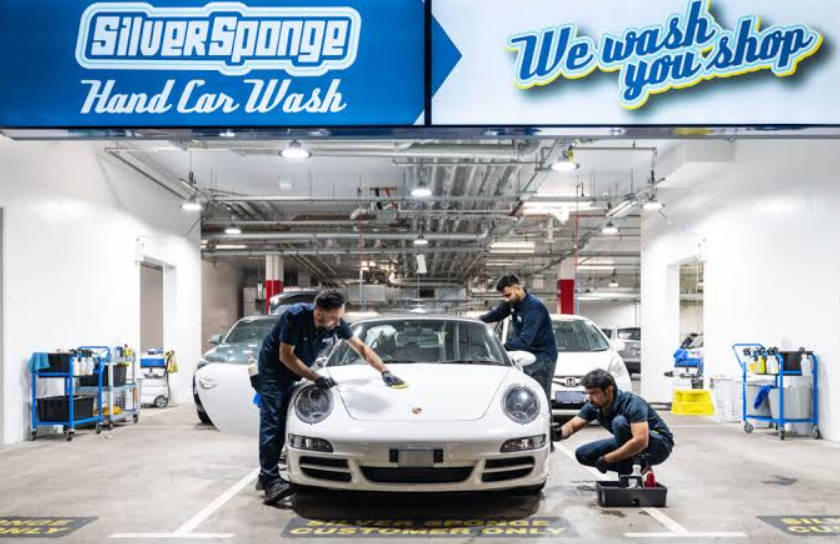
Silver Sponge provides a range of professional car wash services, including interior and exterior washing, premium washing and additional cleaning options.
For a Victoria Park driver, a professional clean can be arranged through the Silver Sponge Victoria Park location, making it practical to combine vehicle care with everyday errands in the area.
Silver Sponge Victoria Park car wash location
Touchless Wash vs Professional Detailing
It is important to understand that washing and detailing are not the same thing.
A wash is primarily concerned with removing everyday contamination.
Detailing goes considerably further.
Professional detailing can involve processes such as:
- Deep interior cleaning
- Carpet and mat cleaning
- Leather cleaning and conditioning
- Paint decontamination
- Clay bar treatment
- Machine polishing
- Paint correction
- Waxing
- Ceramic coating
- Interior protection
Silver Sponge’s detailing services currently include express detailing, cut and polish, interior detailing, full detailing, interior protection and ceramic coating.
If your vehicle simply needs regular maintenance, a car wash may be appropriate.
If the paint looks dull, the interior is heavily soiled or the vehicle has accumulated stubborn contamination, detailing may be the more appropriate solution.
Explore professional car detailing services
How to Get Better Results From Any Car Wash
Regardless of the washing method, a few simple habits can make a significant difference.
Don’t leave contaminants sitting on the paint
Bird droppings, insects, tree sap and other contaminants should be dealt with promptly where practical.
Wash before the vehicle becomes heavily contaminated
Regular maintenance is usually easier than trying to restore a vehicle after months of accumulated grime.
Pay attention to the wheels
Brake dust and road contamination can build up quickly on wheels.
They often require dedicated cleaning products and equipment.
Don’t ignore the interior
A vehicle can look clean externally while the cabin contains dust, stains, food residue and odours.
Regular vacuuming and surface cleaning help prevent the interior from becoming difficult to restore.
Choose the service according to condition
A quick wash may be enough for a lightly dirty commuter vehicle.
A heavily contaminated family car may need a more comprehensive service.
Is a Touchless Car Wash Worth It?
For the right situation, yes.
A touchless car wash can be a convenient way to remove loose dirt while reducing direct physical contact with the vehicle’s paint.
But it is not a magic solution.
The cleaning result depends on the contamination, cleaning chemistry, water pressure, dwell time and drying process. Heavy or bonded contamination can remain after a touchless wash.
For vehicle owners who care about maintaining their paintwork, the smarter approach is to view touchless washing as one option within a broader car care routine, rather than automatically treating it as the safest or most effective method for every situation.
If the vehicle needs a more thorough clean, controlled hand washing and professional detailing can provide greater attention to the areas that automated or touchless systems cannot address.
Touchless Car Wash FAQs
1. What is a touchless car wash?
A touchless car wash cleans a vehicle primarily using cleaning chemicals and high-pressure water without brushes, sponges or wash mitts physically contacting the exterior paint.
2. Is a touchless car wash better for car paint?
It can reduce physical contact with the paint, which may reduce some risks associated with contaminated washing tools. However, touchless washing is not automatically better in every situation.
3. Can touchless washing remove heavy dirt?
It can remove loose and some heavier contamination, but bonded road film, tar, tree sap, dried insects and other stubborn contaminants may require additional treatment.
4. Does a touchless car wash prevent swirl marks?
Reducing physical contact can reduce one potential source of wash-induced marks, but it cannot guarantee that a vehicle will never develop swirl marks or other paint imperfections.
5. Can I use a touchless wash on a ceramic-coated car?
Generally, touchless washing can form part of a ceramic coating maintenance routine, provided the cleaning products and process are compatible with the coating.
6. How often should I wash my car?
There is no single ideal frequency for every vehicle. Driving conditions, weather, parking location, contamination and paint protection all influence how often a vehicle should be cleaned.
7. Is a hand car wash better than a touchless car wash?
For vehicles requiring targeted cleaning or more attention to specific areas, a professional hand wash can provide greater control. For light routine contamination, touchless washing can be convenient.
8. Can a touchless wash replace car detailing?
No. Detailing involves much more than removing surface dirt and can include paint decontamination, polishing, interior cleaning, paint correction and protective treatments.
9. Should bird droppings be removed quickly?
Yes. Bird droppings should not be left on automotive paint unnecessarily. Prompt, careful removal can help reduce the risk of staining or etching.
10. Where can I get a professional car wash in Victoria Park?
Silver Sponge operates a Victoria Park location at 78–80 Canning Highway, Victoria Park, WA 6100. The business also provides a range of car wash and detailing services across Perth.
Conclusion
A touchless car wash has genuine advantages, particularly when reducing physical contact with the vehicle’s exterior is a priority. However, it is important not to confuse “touchless” with “perfectly clean” or “completely risk-free”.
The right cleaning method depends on the vehicle’s condition and the type of contamination it has accumulated.
For lightly dusty vehicles, touchless washing can be a convenient maintenance option. When road film, stains, stubborn contamination or paint imperfections become more noticeable, a professional hand wash or detailing service can provide a more thorough solution.
The key is consistency. Regular, appropriate vehicle care is far better than allowing contamination to build up until the car requires extensive restoration.
For drivers around Victoria Park, Silver Sponge provides professional hand car washing and detailing services designed around different levels of vehicle care.
Visit Silver Sponge Victoria Park
When you’re ready to have your vehicle professionally cleaned, you can also explore Silver Sponge’s car wash services or book a service online.